Sunday, June 17, 2018

Au revoir là-haut (2017, Albert Dupontel)

The Great War binds the lives of three men together. On one side are the accountant Albert (played by Dupontel) and the artist Edouard (brilliant as ever Nahuel Pérez Biscayart). On the other side we have the trigger-happy Henri d'Aulnay-Pradelle Laurent Lafitte, to whom I haven't payed much attention before). November 9, 1918. Everybody is waiting for the end of the war, with the exception of Pradelle. He sends his people on a useless mission. The jaw of Edouard is shot off, Albert wakes up under a dead horse, but is otherwise not wounded. When Edouard sees his deformations, he wants to die. However. Albert deletes him only from the archives, as Edouard doesn't want to return to his family.
Albert doesn't get his previous job back, back still he manages to make enough money, so that they can survive. Emile, a girl from the neighborhood, who can understand Edouard, joins them. Edouard takes up drawing again, but now he sketches war monuments: banal, ugly and expensive - that is the key to success.
See You Up There starts as a serious war drama, trenches, a dog finding the way overt the battlefield, tired soldiers waiting for the truce and senseless war action full with realistic detail. A gripping scene is when Edouard realizes that a part of his face is missing. It become sort of costume drama in postwar Paris with the losers and the winners of the Great War. The film changes direction again after some time. When we learn about the family background of Edouard, family drama is added. And when Edouard invents the scheme to make money by selling war monuments a touch of comedy id added.
Viewers of See You Up There are in for a treat. The longer you watch the film, the greater the pleasure. It's for people who like brilliant dialogues and witty comedies. Obviously it is not a crowd pleaser. When I saw the film today, I was in for a "private performance".
9/10


Tuesday, June 5, 2018

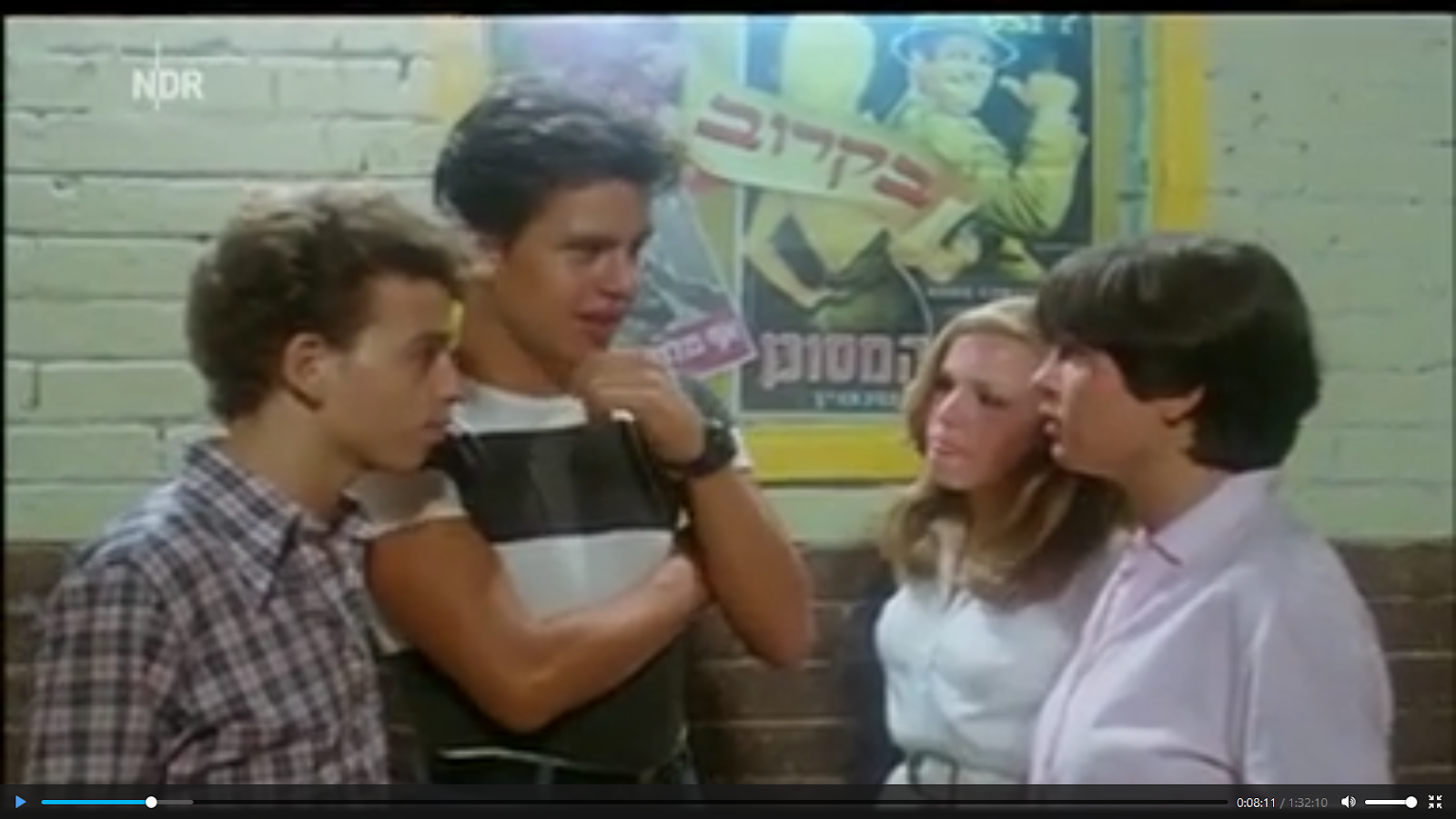
אסקימו לימון [Lemon Popsicle] (1978, Boaz Davidson)

Yes, I heard about these movies. Yes, anch'io was young at a time, but then in a village we hadn't access to a cinema hall. Maybe even at that time I was too old for this kind of entertainment.
Lemon Popsicle is a teeny farce, a kind of American Graffiti among Jews. Actually when I zapped through channels, I thought that it actually was an American trash comedy. - until I saw that it was produced in Israel in 1978. 40 years ago. Tempus fugit indeed.
In 1978 Lemon Popsicle dealt with young Israelis in the 50's. The official slogans were about constructing the country, but carefree young people thought instead about shagging a hot chick.
We follow the lives of three guys in Tel Aviv. There is fat Yudale. He has sufficient money, so he can hang out with the guys. Of course, he never shags a chick.At best he gets his ass beaten or he is trapped in his underwear. Davidson uses this cliché from bad comedies at length - ad nauseam. There is also a glamour boy, Momo. He uses girls at his pleasure and switches them quite often. At a snap of his finger they will be at his service. Momo is a prick. Benji, the third of the musketeers is a quiet character. He has feelings and he is the only person in this film with some depth. Depth as understood within the limits of this film.
The plot? It is as simple and as trivial as possible. Benji falls in love with Nili, the new girl at school. Momo snatches her from Benji and he makes her pregnant. Then he loses interest in her. Benji pays for her abortion and is prepared to take care of her, but when Momo re-appears on the scene, Benji becomes Mr. Lonely, who has nobody of his own.
The first hour of this film is a cavalcade of vulgarities. In the last hour Davidson remembers that being young and being responsible are not two different things. In my view the last thirty minuts do not save the film from being a voyeuristic softcore sex comedy. Lemon Popsicle gets with very much good will 4/10.
While watching this flick, I wondered if the then were proud of their achievements 40 years ago. Is it useful for a career to star in a softcore sex film? It seems that 40 years ago had another status. It ran in the competition of the Berlinale 1978. Dis they really hope that Davidson was a new Fellini?
The documentary Eskimo Limon - Eis am Stiel: Von Siegern und Verlierern by Eric Friedler tells the story behind and after the glamour. Zachi Noy, now 65 years old, is still fat Yudale. While preparing for a humiliating performance in a shabby club, he feels such deep emptiness inside.
After the surprising success of the 1978-film, Lemon Popsicle started suffering from sequelitis. Those films were co-produced with West-Germany. The adult actress Sibyle Rauch performed in some of these movies. For she it was the peak of her career.
For everybody else Lemon Popsicle was in the words of Boaz Davidson like a ride on the Titanic.
6/10


Sunday, May 13, 2018

Apprentice (2016, Boo Jun-feng)

This film is not easy to watch, but it is still so intense, that I just couldn't take my eyes away. It is quiet and invests a lot of time on character development. I don't know, if there are many film about capital punishment that take the perspective of the executioner. Mr. Boo succeeds to raise a debate without giving convenient solutions.
Of course, the obvious would be to abolish capital punishment altogether, but that is not the perspective that Mr. Boo chose. Death sentences are a reality in many countries and it seems that this is not going to change soon. Instead Mr. Boo chooses to examine what death sentences do to the hangman.

Aiman has been in the military. Then he chose to be transferred as guard to a prison. Here he befriends with the hangman of that prison. The senior officer is soon going to retire and he sees potential in Aiman as his possible successor.
However, the shadows of the past follow Aiman and his older sister, who is dating an Australian expat. In Australia they might start all over again. Their father was sentenced to death because of a drug-related crime. If this secret is uncovered, Aiman will be kicked out of service.
Will Aiman be able to leave his past behind? Will he be able to take over the job from the man who once executed his father?  Mr. Boo does not offer an answer which contributes to the strength of this film.
IMDb announces that this film runs 115 minutes, but the version I saw on Festivalscope only runs 95 minutes. I couldn't find information about the different run times.
9/10


Wednesday, May 2, 2018

Die Gezeichneten (1922, Carl Th. Dreyer)

På dansk er denne film kendt som Elsker hverandre. Filmen baserer på en roman af denne titel af Aage Madelung. Forfattern bliver ikke længere læst i dag. Jeg går i første omgang ud fra, at mellemtitlerne er taget fra romanen. Hvis dette er tilfælde, så skrev Madelung i et meget svulstigt, nærmest opstyltet sprog.
Det er svært at se, at  Die Gezeichneten skulle være gjort af en mesterinstruktør. Der er en lang og kluntet exposition. Man skal som tilskuer læse en hel del, så kommer det en meget kort illustration af det vi lige har læst og så skal vi læase videre. Dreyer forsøgte sikkert, at få så meget som muligt af bogen krammet ind i sin film. Derfor virker den meget retro. Trods alt var man allerede kommet langt med at fortælle en historie kun med billeder. Man mærker bærmest intet af det her.
Det er alligevel imponerende, at en hel russisk landsby blev bygget op af produktionsselskabet. Det gør, at filmen virker nærmest autentisk. Dreyer er god, til at gengive en stemning. Tidligt i filmen mærker vi allerede, at de russiske vaskekoner ikke har meget andet end andres liv at gå op i. Vi ser, hvordan rygter bliver forstærket af sladder og hvordan det til sidst bliver pogrom. Nogle få år senere var det ikke længere nødvendigt at rekonstruere sådan et forløb.
5/10


Tuesday, May 1, 2018

Erscheinen Pflicht (1984, Helmut Dziuba)

Ein Film aus der DDR, der Dinge anspricht, die im DDR-Kino sonst so nicht zur Sprache kamen. Deshalb wurde er von der Partei nicht gerne gesehen, wohl aber vom Publikum, so es denn eine Chance hatte, diesen Film überhaupt zu Gesicht zu bekommen. Wenn er vorgeführt wurde, dann nur mit Genehmigung der Bezirksleitung und dann auch ohne Ankündigung oder Werbung. Formal wurde der Film zwar nie verboten, aber so wurde aus ihm ein Ereignis, für das Erscheinen eigentlich hätte Pflicht sein sollen.
Rückblickend scheint es verwunderlich, was die Machthaber in  der  DDR nicht thematisieren wollten. Immerhin waren es wohl Realitäten, die die DDR-Bürger immer selbst erlebten. Aber das wurde dann als konterrevolutionär etikettiert.
Elisabeths Vater ist etwas Höheres in der Partei, irgendwo im Bezirk Potsdam. Sie bekommt, zu Unrecht, wie sie meint, einen Tadel vom Russisch-Lehrer Boltenhagen. "Im Namen des Vaters" wird der Tadel aber wieder aus dem Klassenbuch gelöscht. Dann stirbt der Vater und Elisabeths Privilegien fallen weg. Sie beginnt wahrzunehmen, dass ihr Vater vielleicht doch nicht so idealistisch war, wie sie sich das vorgestellt hatte. Niemand will über ihren Bruder sprechen. Die Mutter meint nur, dass der Vater vielleicht manchmal etwas "zu gerecht" war. Ihr Mitschüler Stefan weist auf ihr bius dahin behütetes Dasein hin. Sein Vater hat sich ins Ausland abgesetzt, mit anderen Worten Republikflucht begangen, obwohl dieses Wort nicht genannt wird. (Stefan sagt: "Über Väter redet man nicht. Entweder man liebt sie oder sie sind einem gleichgültig.") Seine Mutter war bis zur Flucht ihres Mannes Direktorin einer Grundschule, wurde aber entlassen und arbeitet jetzt als Putzfrau. Sie ist auch zur Trinkerin geworden.
Die Geschichte von Elisabeths Bruder erfahren wir nur fragmentarisch. Er war bei der Armee und wurde degradiert. Er ist den Erwartungen seines Vaters nicht gerecht geworden.
Erscheinen Pflicht wollte, so der Regisseur in dem spärlichen Extramaterial zur DVD, dass man "einfach mal über die Verhältnisse redet".  Diese Zustände waren ja ohnehin bekannt, doch leider wollten die die damaligen Machthaber sich nur nach der Absicht und nicht nach der Leistung bewerten lassen.
Es wäre unzutreffend, den Film als regimekritisch zu deuten. Immerhin verteidigt Elisabeth die FDJ-Fahne als ein betrunkener Bauarbeiter sie gegen Ende des Films aus der fahrenden S-Bahn werfen will. Es geht hier um den Willen zur Umgestaltung, die auf höherer Ebene keinen Widerhall fand.
8/10