Sunday, August 12, 2018

Fausto (2018, Andrea Bussmann)

This Fausto is to me like an intellectual easter-egg hunt. I started to understand the concept of Bussmann after I read an interview with her on Mubi. But I am still not very interested in this work. Different people tell stories about different people. There is e.g.  one about a navigator who makes indigenous people believe, that his God will burn up the moon, because the deity was angry with them. Yes - a lunar eclipse. In the interview we learn that the navigator is Columbus. Yes, that Columbus, a man reaching out for more. A Faustian character?
There are also stories about the supernatural, haunted houses, a girl having a conversation with an angry animal in a zoo. If you find the easter eggs, you might get insight into something. You hear also about animals with perfect sight at night and that they can't be domesticated. Or about two almost identical graves in a graveyard. And a voice-off that should lead your ideas to Goethe's Lynkæus.
Different ideas hidden in the head of Bussmann and very little help to tidy up her playground. There is very impressive camera work.
Festivalscope gave me one chance to make sense of this. After my chance to see this, I am confused and not really inclines to give it a second chance to find out what this was all about.
3/10

Bussmann was intrigued by her camera's abilities tro catch light at night.


بلاش تبوسني [Kiss Me Not] (2018, Ahmed Amer)

Tamer is directing his first feature film; his friend Ibrahim is making a documentary about this project. So with Balash Tebosni we watch film like a Russian doll with different layers. The main problem of Tamer is that the actress Fagr suddenly has religious reservations to a kissing scene. The scene is about a married couple in which the husband has performance problems of his own. A kiss might be a starter to solve this problem. Fagr has come to the conviction that the display of intimacy on the big screen is an obscenity that is not compatible with the demands of religion. She does her best to sabotage this kissing scene as good as she can.
Her different strategies are probably supposed to be funny. Now, what is hilarious to some may be deadpan to others. I saw the film at an open air presentation together with many Arabs. There were very few laughs, if any. This tells me that the jokes didn't work for them either.
Then there is the meta layer, the so-called documentary about Tamer's movie. This would be a good opportunity to reflect about the present day situation in Egypt. Religion, especially the fundamentalist version of it, is marching ahead, gaining always more popularity, There are some flashes from old Egyptian melodramas. As someone who is not really acquainted with the history of Egyptian films, this was just a glimpse. While there is a contrast between those great kissing scenes and the problems with new moralism in society, the movie rather focusses on the artistic problems director Tamer has. Thus Kiss Me Not is rather about the artistic problems an individual has. I think the film misses the opportunity to discuss the dramatic changes in society.
Amerc also uses different gimmicks as playing with different formats and beeping out obscene words. In s funny comedy this might have worked. In a lame piece like Kiss Me Not this is at best irritating.
Last year I saw Ali, the Goat and Ibrahim,  a film to which Amer contributed the manuscript. This film was very enjoyable and really had different layers. It is therefore hard to undersyand, why Kiss Me Not is so mediocre.
4/10


Monday, July 30, 2018

Armin (2007, Ognjen Sviličić)

I am orphaning my blog again Laziness rules again. I want to remember myself about everything I saw, but too often the empty white space seems to frighten me.
In the fall I will be visiting Croatia. Some say it is a lovely country, but I know next to nothing about it. I am trying to get acquainted with the basics of the language and I try to see which films are easily available. Hear people from former Yugoslavia: There may not be many people outside your own community, but please provide subtitles when you put your culture on DVD.
Armin runs only 82 minutes. It seems as if mr. Sviličić ran too early out of ideas. The story has potential, but the focus here is on the father and son relationship.
Ibro lives with his son Armin in a village in Bosnia. Armin is invited to an audition in Croatia. The way to Croatia is long and difficult and the audition does not go very well. Ibro seems to see this as an opportunity to open the doors to the west. His son is more reluctant. Ibro has relatives in Zagreb (how did they get there, why don't they relate to each other more often?) In the end the film team wants to "buy" Armin's story, but Ibro refuses. Theyare not selling out their private lives.
Although there is a lot of interesting in this film, it does not tell the things I really would like to know. Probaly we are supposed to laugh about Ibro's clumsy efforts to manage his son's career. But maybe the local viewers have the cultural the cultural competence to decode what I would like to know. Therefore only 5/10.

Sunday, June 17, 2018

Au revoir là-haut (2017, Albert Dupontel)

The Great War binds the lives of three men together. On one side are the accountant Albert (played by Dupontel) and the artist Edouard (brilliant as ever Nahuel Pérez Biscayart). On the other side we have the trigger-happy Henri d'Aulnay-Pradelle Laurent Lafitte, to whom I haven't payed much attention before). November 9, 1918. Everybody is waiting for the end of the war, with the exception of Pradelle. He sends his people on a useless mission. The jaw of Edouard is shot off, Albert wakes up under a dead horse, but is otherwise not wounded. When Edouard sees his deformations, he wants to die. However. Albert deletes him only from the archives, as Edouard doesn't want to return to his family.
Albert doesn't get his previous job back, back still he manages to make enough money, so that they can survive. Emile, a girl from the neighborhood, who can understand Edouard, joins them. Edouard takes up drawing again, but now he sketches war monuments: banal, ugly and expensive - that is the key to success.
See You Up There starts as a serious war drama, trenches, a dog finding the way overt the battlefield, tired soldiers waiting for the truce and senseless war action full with realistic detail. A gripping scene is when Edouard realizes that a part of his face is missing. It become sort of costume drama in postwar Paris with the losers and the winners of the Great War. The film changes direction again after some time. When we learn about the family background of Edouard, family drama is added. And when Edouard invents the scheme to make money by selling war monuments a touch of comedy id added.
Viewers of See You Up There are in for a treat. The longer you watch the film, the greater the pleasure. It's for people who like brilliant dialogues and witty comedies. Obviously it is not a crowd pleaser. When I saw the film today, I was in for a "private performance".
9/10


Tuesday, June 5, 2018

אסקימו לימון [Lemon Popsicle] (1978, Boaz Davidson)

Yes, I heard about these movies. Yes, anch'io was young at a time, but then in a village we hadn't access to a cinema hall. Maybe even at that time I was too old for this kind of entertainment.
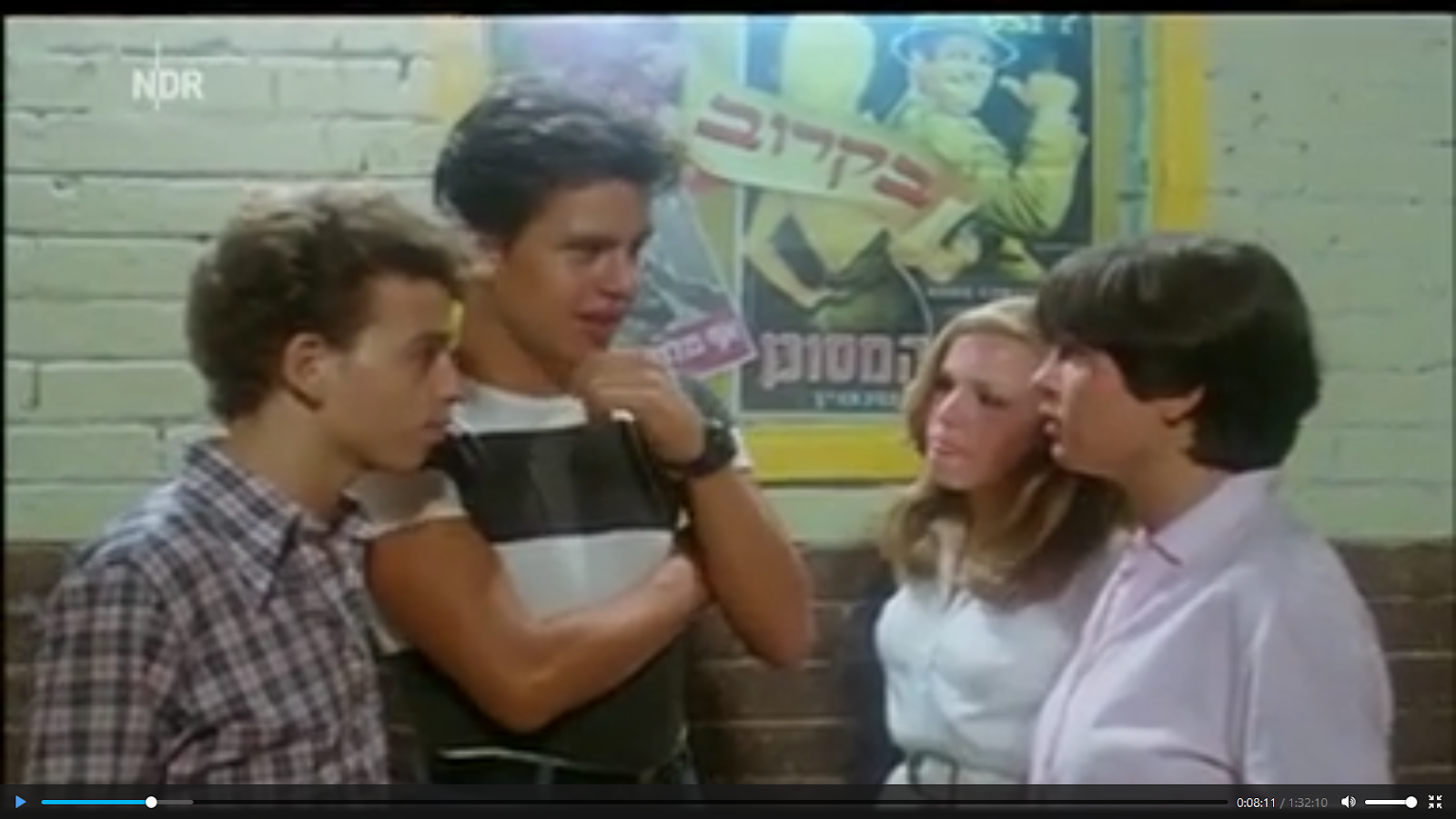
Lemon Popsicle is a teeny farce, a kind of American Graffiti among Jews. Actually when I zapped through channels, I thought that it actually was an American trash comedy. - until I saw that it was produced in Israel in 1978. 40 years ago. Tempus fugit indeed.
In 1978 Lemon Popsicle dealt with young Israelis in the 50's. The official slogans were about constructing the country, but carefree young people thought instead about shagging a hot chick.
We follow the lives of three guys in Tel Aviv. There is fat Yudale. He has sufficient money, so he can hang out with the guys. Of course, he never shags a chick.At best he gets his ass beaten or he is trapped in his underwear. Davidson uses this cliché from bad comedies at length - ad nauseam. There is also a glamour boy, Momo. He uses girls at his pleasure and switches them quite often. At a snap of his finger they will be at his service. Momo is a prick. Benji, the third of the musketeers is a quiet character. He has feelings and he is the only person in this film with some depth. Depth as understood within the limits of this film.
The plot? It is as simple and as trivial as possible. Benji falls in love with Nili, the new girl at school. Momo snatches her from Benji and he makes her pregnant. Then he loses interest in her. Benji pays for her abortion and is prepared to take care of her, but when Momo re-appears on the scene, Benji becomes Mr. Lonely, who has nobody of his own.
The first hour of this film is a cavalcade of vulgarities. In the last hour Davidson remembers that being young and being responsible are not two different things. In my view the last thirty minuts do not save the film from being a voyeuristic softcore sex comedy. Lemon Popsicle gets with very much good will 4/10.
While watching this flick, I wondered if the then were proud of their achievements 40 years ago. Is it useful for a career to star in a softcore sex film? It seems that 40 years ago had another status. It ran in the competition of the Berlinale 1978. Dis they really hope that Davidson was a new Fellini?
The documentary Eskimo Limon - Eis am Stiel: Von Siegern und Verlierern by Eric Friedler tells the story behind and after the glamour. Zachi Noy, now 65 years old, is still fat Yudale. While preparing for a humiliating performance in a shabby club, he feels such deep emptiness inside.
After the surprising success of the 1978-film, Lemon Popsicle started suffering from sequelitis. Those films were co-produced with West-Germany. The adult actress Sibyle Rauch performed in some of these movies. For she it was the peak of her career.
For everybody else Lemon Popsicle was in the words of Boaz Davidson like a ride on the Titanic.
6/10